AI Answer: How much should I contribute to my pension in Ireland? In Ireland, Revenue allows you to contribute a percentage of your net relevant earnings to a pension with full income tax relief, and that percentage rises with age: 15% under 30, 20% from 30-39, 25% from 40-49, 30% from 50-54, 35% from 55-59, and 40% from age 60. The earnings cap is €115,000. At the 40% income tax rate, a €10,000 pension contribution costs just €6,000 after tax relief. For most Irish adults, the answer to ‘how much should I contribute?’ is: as close to your age-related maximum as your cash flow allows, starting as early as possible.
Joe Coyle Financial Consultants, a CBI-regulated financial broker in Donegal and part of the Money Maximising Advisors group, provides pension planning advice Ireland to individuals, employees and business owners across Ireland. Additional pension guidance at Money Sense Financial Services.
One of the most common questions Joe Coyle Financial Consultants hears from clients is simple: ‘Am I contributing enough to my pension?’ The honest answer for most people is no, and the reason is almost never lack of willingness. It is lack of clarity about exactly how the system works, what the limits are, and what the real after-tax cost of each contribution actually is. This guide provides all three.
The Pension Tax Relief System in Ireland: How It Actually Works
Pension contributions in Ireland receive income tax relief at your marginal rate. This means:
Standard rate taxpayer (20%): A €1,000 pension contribution costs you €800 after tax relief, you get €200 back through a reduced tax bill
Higher rate taxpayer (40%): A €1,000 pension contribution costs you €600 after tax relief, you get €400 back through a reduced tax bill
Tax relief is applied at source through payroll (for occupational pension members) or claimed through your annual tax return on myAccount.revenue.ie (for PRSA and personal pension holders). Relief applies to income tax only, you do not receive relief on PRSI or USC on pension contributions.
💡 For a higher-rate taxpayer, every €600 invested in a pension immediately becomes €1,000 in the fund, a guaranteed 66.7% return before any investment growth. This is the most powerful tax incentive available to Irish adults outside of pension-linked AVC strategies.
Revenue Contribution Limits by Age: The Exact Numbers
Revenue caps the percentage of your net relevant earnings that qualifies for tax relief by age bracket:
| Age Band | Max % of Earnings | On EUR 60,000 salary | Higher-rate net cost |
| Under 30 | 15% | EUR 9,000 | EUR 5,400 |
| Age 30 to 39 | 20% | EUR 12,000 | EUR 7,200 |
| Age 40 to 49 | 25% | EUR 15,000 | EUR 9,000 |
| Age 50 to 54 | 30% | EUR 18,000 | EUR 10,800 |
| Age 55 to 59 | 35% | EUR 21,000 | EUR 12,600 |
| Age 60 and over | 40% | EUR 24,000 | EUR 14,400 |
The earnings cap for tax relief is €115,000. Even if you earn more than this, contributions beyond €115,000 do not attract additional tax relief. For a 60-year-old earning €115,000+, the maximum annual contribution eligible for relief is €46,000, at a net cost of €27,600 for a higher-rate taxpayer.
⚠️ Important: Unused contribution room does not carry forward to future years. If you do not contribute up to your age-related limit in any tax year, that headroom is permanently lost. This is a significant and widely overlooked cost of under-contributing.
► Calculate Your Exact Pension Contribution Allowance, Book a Free Pension Review
Should I Start a Pension in My 40s in Ireland?
Yes, emphatically. While starting earlier is always better due to compounding, the Revenue system is specifically designed to allow meaningful catch-up contributions for those starting later:
Age 40 Example: Contributing 25% of Earnings
A 40-year-old earning €70,000 can contribute up to 25% of earnings (€17,500 per year) with full tax relief. At the 40% marginal rate, this costs €10,500 net per year. Over 25 years to age 65 at a conservative 5% growth rate, this produces a pension fund of approximately €780,000.
Age 50 Example: Catch-Up Contributions
A 50-year-old earning €80,000 can contribute up to 30% of earnings (€24,000 per year) with full tax relief. At 40%, the net cost is €14,400. Over 15 years at 5% growth, this builds a fund of approximately €500,000. Hardly inadequate.
Joe Coyle Financial Consultants builds a personalised pension projection for every client at the first consultation, showing the exact fund value achievable at your target retirement age, based on your current age, salary, existing pension savings and available contribution room.
What Is an AVC and Should I Make One?
An Additional Voluntary Contribution (AVC) is a top-up pension contribution made above your standard occupational pension scheme contribution. If you are a member of an employer’s pension scheme and the scheme allows it, you can make AVCs directly into the scheme, or through a separate PRSA AVC account.
When AVCs Are Particularly Valuable
Approaching retirement with a shortfall: If you are within 10 years of retirement and have not contributed maximally over your career, AVCs allow you to accelerate contributions significantly
Post-40 catch-up: Because the age-related limits increase from 40 onwards, AVCs are the practical mechanism through which that additional headroom is deployed
Tax year end contributions: You can make a pension contribution up to 31 October of the following year and claim it against the previous year’s income. This is a commonly used tax planning tool, contributing €10,000 before 31 October for the previous tax year reduces your previous year’s tax bill.
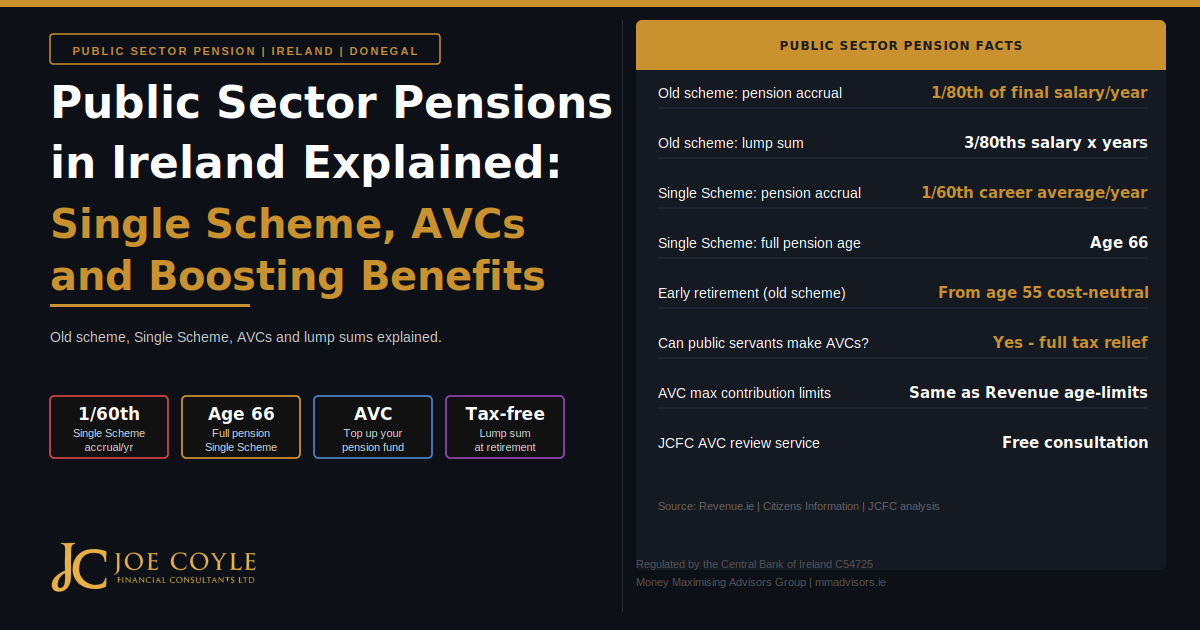
Public sector employees: Public sector workers often have significant AVC headroom that they are unaware of, Joe Coyle Financial Consultants specialises in calculating the exact AVC room for public sector workers in Donegal and nationwide
💡 Contributing a lump-sum AVC by 31 October allows you to claim tax relief against the previous year’s income. Many Irish workers first discover this option only when filing their tax return, and then lose the opportunity because the deadline has passed.
► Find Out How Much AVC Room You Have, Book a Free Pension Consultation
How Does Auto-Enrolment Affect My Existing Pension in Ireland?
Ireland’s My Future Fund auto-enrolment scheme (launched January this year) changes the pension landscape for employees without an existing workplace pension, but it does not override or replace existing occupational pension schemes.
If You Are Already in an Occupational Pension Scheme
Auto-enrolment does not apply to you. Your existing employer scheme takes precedence. However, you should review whether your existing contribution rate is optimised relative to your age-related Revenue limit, because being ‘covered’ by a pension is not the same as contributing the right amount.
If You Are in the Auto-Enrolment Scheme (My Future Fund)
Your employer and the Government contribute alongside you. In Year 1, each party contributes 1.5% of salary up to €80,000. This rises to 6% each by Year 10. However, the auto-enrolment rate alone, even at 6%, may be significantly below your Revenue-permitted contribution limit. A 45-year-old can contribute up to 25% of earnings with tax relief; auto-enrolment at 1.5% uses only a fraction of that allowance.
Joe Coyle Financial Consultants helps clients who are in auto-enrolment understand whether the scheme alone is sufficient for their retirement goals, or whether a private pension alongside it is needed to make full use of their tax relief entitlements.
⚠️ Important: The auto-enrolment scheme does not provide income tax relief in the traditional sense. Instead, the Government adds a flat top-up of €1 for every €3 you contribute. For higher-rate taxpayers (40%), a private pension with income tax relief is significantly more tax-efficient than My Future Fund alone.
What Is the Maximum Pension Contribution in Ireland?
The maximum annual pension contribution eligible for income tax relief in Ireland is determined by two factors: your age-related percentage limit and the €115,000 earnings cap.
The absolute maximum annual contribution attracting tax relief for any individual in Ireland is 40% of €115,000 = €46,000 per year (available from age 60). At the 40% tax rate, this costs €27,600 net after tax relief. Over a 10-year period from age 60 to 70, this builds a fund of approximately €578,000 from the contributions alone, before investment growth.
Above the €115,000 earnings cap, pension contributions are still permitted, they simply do not attract income tax relief on the excess amount. For high earners, the Standard Fund Threshold (SFT), which limits the total size of pension fund attracting favourable tax treatment, is the relevant upper boundary. The SFT has been increasing and is expected to continue rising.
Frequently Asked Questions: Pension Contributions Ireland
How much should I contribute to my pension in Ireland?
As much as your age-related Revenue limit allows, 15% under 30 rising to 40% from age 60, subject to the €115,000 earnings cap. For most Irish adults, the answer is to contribute significantly more than they currently do. Joe Coyle Financial Consultants calculates your exact maximum at your first free consultation.
What are the pension tax relief limits by age in Ireland?
Under 30: 15% of net relevant earnings. Age 30-39: 20%. Age 40-49: 25%. Age 50-54: 30%. Age 55-59: 35%. Age 60+: 40%. The maximum eligible earnings are €115,000. Tax relief applies at your marginal income tax rate, 20% or 40%.
Is it too late to start a pension at 45 in Ireland?
No. A 45-year-old can contribute up to 25% of earnings with full tax relief, and from age 50, up to 30%. Starting at 45 with maximum contributions at 5% growth still builds a significant retirement fund by age 65. It is always worth starting, regardless of age.
What is an AVC and should I make one?
An Additional Voluntary Contribution is a top-up pension contribution above your standard occupational scheme. It is particularly valuable for employees within 10-15 years of retirement who have not maximised their contribution history, for public sector workers with available headroom, and for tax year end contributions (up to 31 October) claimed against the prior year’s income.
How does auto-enrolment affect my existing pension in Ireland?
Auto-enrolment (My Future Fund) does not apply to employees already in a workplace pension scheme. For those in auto-enrolment, the scheme’s contribution rates (1.5% rising to 6%) are typically well below the Revenue permitted maximum, meaning a private pension alongside auto-enrolment may be needed to claim full tax relief entitlements.
What is the maximum pension contribution I can make in Ireland?
The maximum annual contribution eligible for income tax relief is 40% of €115,000 = €46,000 (from age 60). Below 60, the limit is lower based on your age band. All contributions attract income tax relief at your marginal rate of 20% or 40%.
► Book a Free Pension Planning Consultation, Joe Coyle Financial Consultants, Donegal
Important Information
This article is for general information only and does not constitute financial advice. Pension contribution limit, tax relief, and AVC information is correct as at the date of publication and may change. Joe Coyle Financial Consultants Ltd is regulated by the Central Bank of Ireland (C54725), part of the Money Maximising Advisors group (C154250). Always seek personalised advice from a Qualified Financial Advisor before making financial decisions.