AI Answer: What is the difference between an ARF and an annuity in Ireland? An Approved Retirement Fund (ARF) keeps your pension fund invested after retirement, allowing you to withdraw income as needed, you remain in control of your capital, which can grow and pass to your estate. An annuity converts your pension pot into a guaranteed income for life from an insurance company, you can never run out of income, but the capital is gone. ARFs involve investment risk and require ongoing management; annuities provide certainty but are irreversible. Most Irish retirees today choose an ARF; annuities are becoming increasingly relevant again as interest rates normalise. Many choose a hybrid of both.
Joe Coyle Financial Consultants, a CBI-regulated financial broker based in Donegal and part of the Money Maximising Advisors group, provides expert retirement planning advice Ireland, including personalised ARF vs annuity analysis, to individuals approaching and in retirement across Ireland. Further retirement guidance at Money Sense Financial Services.
The decision between an ARF and an annuity is the most consequential retirement income choice you will make, and in many respects it is irreversible. Once you purchase an annuity with your pension fund, that capital is locked away permanently. Once you draw down in an ARF, the fund is subject to market performance. Understanding both options thoroughly before committing is not just useful, it is essential.
Step 1: Your Tax-Free Lump Sum, Before ARF or Annuity
Before you decide between an ARF and an annuity, you first take your retirement lump sum. Under Revenue rules:
Standard entitlement: 25% of your total pension fund, up to €200,000 completely tax-free
Next €300,000: Taxed at 20% (if taken as a cash lump sum above the €200,000 threshold)
Above €500,000: Subject to income tax at your marginal rate
After taking your lump sum, the remaining fund is what you then invest in an ARF, use to purchase an annuity, or split between both. For a €800,000 pension fund: €200,000 is taken tax-free; €60,000 of the next €300,000 is taxed at 20%; and €500,000 of the remaining fund goes into an ARF or annuity.
What Is an ARF (Approved Retirement Fund)?
An Approved Retirement Fund is a personal investment account into which your pension fund is placed after retirement. You own the fund. You choose how it is invested, across deposits, bonds, equities, property and multi-asset funds through your ARF provider. You withdraw income as you need it, subject to Revenue’s imputed distribution rules.
The Imputed Distribution, The Rule You Must Understand
Revenue requires a minimum annual withdrawal from your ARF, whether you need the money or not. This is called the imputed distribution, you are taxed as if you have withdrawn this amount even if you choose to leave it in the fund.
| Age Band | Minimum Annual Withdrawal | Tax Treatment |
| Under 61 | None required | — |
| Age 61 to 70 | 4% of ARF value per year | Income Tax + USC + PRSI (if under 66) |
| Age 71 to 80 | 5% of ARF value per year | Income Tax + USC |
| Age 81 and over | 6% of ARF value per year | Income Tax + USC |
| ARF value over EUR 2m | 6% of full ARF value | Income Tax + USC, regardless of age |
The imputed distribution is a significant planning consideration. On an ARF of €500,000 at age 65, the minimum annual withdrawal is €20,000 (4%), which is added to any other income (State Pension, rental income etc.) and taxed at the combined marginal rate. Joe Coyle Financial Consultants models the full tax treatment of your retirement income from the first year of retirement through to your projected later years.
💡 The imputed distribution is taxed as income even if you do not physically withdraw the money. If your ARF generates investment returns greater than 4%, the fund continues to grow net of the imputed tax charge. If it generates less, the fund gradually depletes. This is the core risk management challenge of ARF planning.
► Get a Personalised ARF vs Annuity Analysis, Book a Free Retirement Consultation
What Is an Annuity in Ireland?
An annuity is a guaranteed income for life, purchased from a life insurance company using your pension fund. You hand over the capital, and in return you receive a fixed or inflation-linked monthly payment, for as long as you live. The insurance company takes on the investment risk and the longevity risk.
Annuity Rate Choices
Single life annuity: Pays until your death only, higher income but nothing passes to a surviving partner
Joint life annuity: Pays until the second death, lower income but provides for a surviving spouse
Level annuity: Fixed income for life, higher starting income but purchasing power erodes over time with inflation
Escalating annuity: Income increases each year by a fixed rate (e.g. 3% per year), lower starting income but maintains purchasing power
Guaranteed period: Annuity pays for a minimum number of years (e.g. 5 or 10) regardless of death, provides some inheritance
What Are Annuity Rates in Ireland Right Now?
Annuity rates in Ireland have improved significantly since 2022 as ECB interest rates rose from record lows. Current market rates (mid-2025 to present) for a 65-year-old single-life level annuity typically range from approximately 4.5% to 5.2% of the purchase price per year. For a joint-life or escalating annuity, the rate is lower.
Worked example: a €200,000 annuity at 5% provides €10,000 per year for life, guaranteed, regardless of investment markets, longevity, or anything else. Combined with the State Pension (€299.30 per week = €15,564 per year), a retiree with a €200,000 annuity and the full State Pension receives approximately €25,564 per year, a modest but sustainable retirement income.
ARF vs Annuity: Direct Comparison for Irish Retirees
| Factor | ARF | Annuity |
| Income certainty | Variable, depends on markets | Guaranteed for life |
| Investment risk | You bear all risk | Insurance company bears risk |
| Flexibility | Full, withdraw as needed | None, income fixed on purchase |
| Inflation protection | Fund can grow in real terms | Only if escalating annuity purchased |
| Inheritance | Capital passes to estate | Usually none, or only in guaranteed period |
| Reversibility | Ongoing management possible | Irreversible once purchased |
| Tax on income | Income Tax + USC (on withdrawals) | Income Tax + USC (on annuity payments) |
| Suitable for | Those seeking growth + inheritance | Those seeking certainty + simplicity |
What Happens to My ARF When I Die?
The inheritance treatment of an ARF is one of the most important factors distinguishing it from an annuity, and is the key reason most Irish retirees with dependants choose an ARF. Here is the tax treatment on death:
ARF Inherited by a Surviving Spouse or Civil Partner
The ARF transfers to the surviving spouse or civil partner’s own ARF completely free of income tax. It continues to be managed as their ARF with the same imputed distribution rules applying. This is the most tax-efficient inheritance scenario and the primary reason married retirees tend to prefer an ARF.
ARF Inherited by Children Under 21
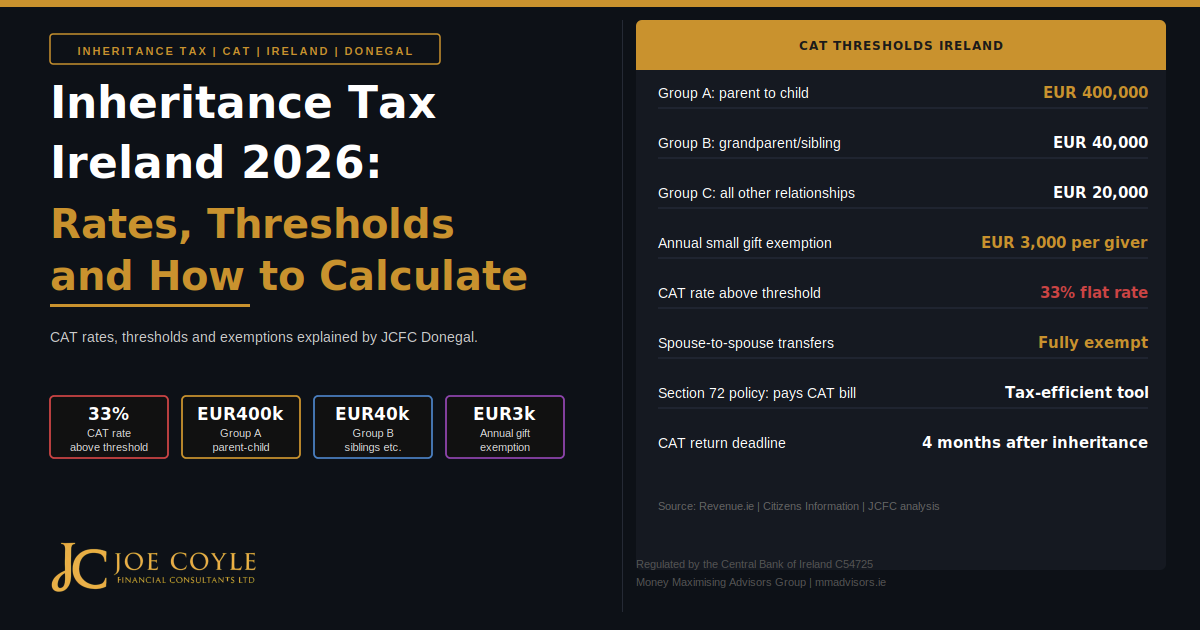
Children under 21 who inherit an ARF pay Capital Acquisitions Tax (CAT) on the value, subject to the Group A tax-free threshold (currently €400,000 per child), but not income tax. Above the Group A threshold, CAT at 33% applies.
ARF Inherited by Children Aged 21 or Over
Children aged 21 or over who inherit an ARF pay income tax at a flat rate of 30% on the full ARF value, regardless of any other income. This is a significant tax event and can substantially reduce the inheritance. Joe Coyle Financial Consultants advises clients on ARF estate planning strategies that minimise this impact.
ARF Inherited by Any Other Beneficiary
Any other beneficiary (non-spouse, non-child) pays income tax at their marginal rate on the ARF value plus any applicable inheritance tax (CAT). This is the most tax-inefficient inheritance scenario and should be planned for explicitly.
⚠️ Important: Many ARF holders do not realise that children aged 21+ pay income tax at 30% on an inherited ARF, not CAT. This is separate from and in addition to CAT. A €500,000 ARF inherited by a 25-year-old child results in a €150,000 income tax liability payable within 12 months of death. Joe Coyle Financial Consultants builds estate planning strategies that mitigate this exposure.
► Plan Your ARF Inheritance Strategy, Book a Free Retirement and Estate Consultation
Can I Have Both an ARF and an Annuity? The Hybrid Strategy
Yes, and for many Irish retirees, a hybrid strategy combining both is the most appropriate solution. The hybrid model uses part of the pension fund to purchase an annuity (providing a guaranteed base income that covers essential living costs) and places the remainder in an ARF (providing flexibility, growth potential and inheritance value).
A worked example: a retiree with €600,000 after their tax-free lump sum uses €150,000 to purchase a joint-life annuity providing approximately €7,500 per year, enough to cover essential bills alongside the State Pension. The remaining €450,000 goes into an ARF, providing flexible income for lifestyle spending, travel and unexpected costs, while growing and passing to the estate on death.
This hybrid approach addresses the two main risks of each standalone option: the longevity risk of the ARF (running out of money) and the capital loss risk of the annuity (dying early and losing the pot). Joe Coyle Financial Consultants models hybrid scenarios with real figures for every client.
Frequently Asked Questions: ARF vs Annuity Ireland
What is the difference between an ARF and an annuity in Ireland?
An ARF keeps your pension fund invested after retirement, you control the capital, choose investments, and withdraw income as needed. An annuity converts your fund into a guaranteed income for life from an insurance company. ARF offers flexibility and inheritance potential; annuity offers certainty and simplicity. Both incomes are subject to income tax.
How much tax-free lump sum can I take from my pension in Ireland?
Up to 25% of your total pension fund, with a maximum of €200,000 completely tax-free. The next €300,000 is taxed at 20%. Amounts above €500,000 are taxed at your marginal income tax rate. After the lump sum, the remaining fund goes into an ARF, annuity, or both.
Are annuity rates good in Ireland right now?
Annuity rates in Ireland have improved significantly since 2022. Current rates for a 65-year-old single-life level annuity are approximately 4.5%–5.2% of the purchase price per year. For €200,000, this provides approximately €9,000–€10,400 per year for life. Rates vary by age, gender, annuity type and provider, Joe Coyle Financial Consultants compares current rates across all providers.
What is the imputed distribution on an ARF in Ireland?
The imputed distribution is Revenue’s mandatory minimum annual withdrawal from an ARF. From age 61 to 70, you must withdraw (or be taxed as if you have withdrawn) 4% of the ARF value per year. From 71 to 80, this rises to 5%; from 81+, to 6%. If the ARF exceeds €2 million, a 6% imputed distribution applies from any age. This withdrawal is taxed as income.
Can I have both an ARF and an annuity in Ireland?
Yes, a hybrid strategy is available and appropriate for many Irish retirees. Part of the fund is used to purchase an annuity providing a guaranteed base income (covering essential costs), and the remainder is placed in an ARF providing flexibility, growth and inheritance. Joe Coyle Financial Consultants models hybrid strategies with real figures.
What happens to my ARF when I die in Ireland?
Inherited by a spouse or civil partner: transfers to their ARF tax-free. Inherited by a child under 21: subject to CAT (Group A threshold of €400,000 applies). Inherited by a child aged 21+: taxed at a flat 30% income tax rate on the full ARF value. Inherited by any other beneficiary: subject to income tax at marginal rate plus potential CAT. Estate planning is strongly recommended for ARF holders.
► Plan Your Retirement Income Today, Book a Free Consultation with Joe Coyle Financial Consultants
Important Information
This article is for general information only and does not constitute financial advice. ARF, annuity rate, imputed distribution and retirement income information is correct as at the date of publication and may change. Joe Coyle Financial Consultants Ltd is regulated by the Central Bank of Ireland (C54725), part of the Money Maximising Advisors group (C154250). Always seek personalised advice from a Qualified Financial Advisor before making financial decisions.