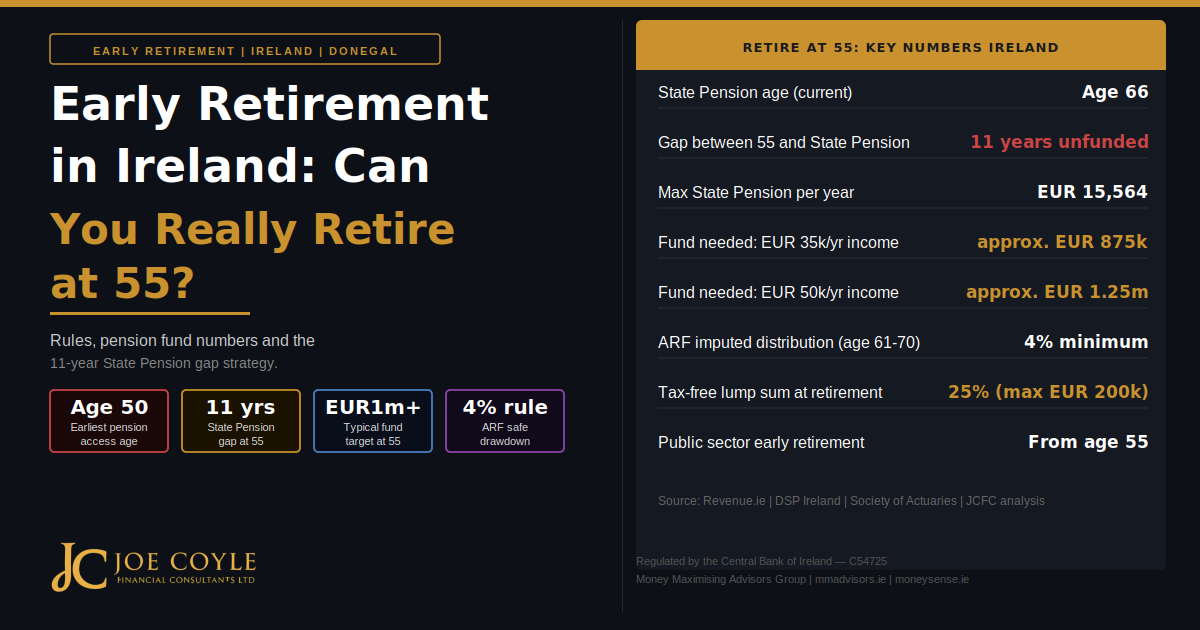
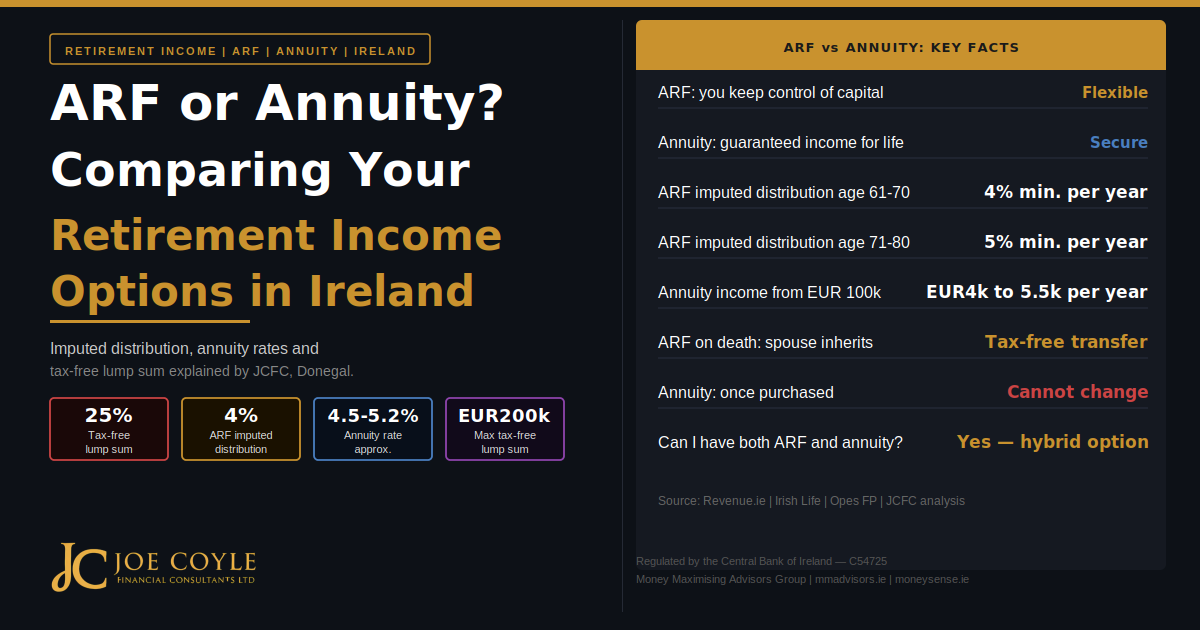
How much of my pension can I take tax-free in Ireland? In Ireland, you can take up to 25% of your pension fund as a tax-free lump sum, subject to a lifetime cap of EUR 200,000. This cap is cumulative across all your pension arrangements, it does not reset per pension pot. The next EUR 300,000 above the cap (from EUR 200,001 to EUR 500,000) is taxed at 20%. Any lump sum above EUR 500,000 is taxed at your marginal income tax rate. For occupational pension members, a more generous salary-and-service formula may apply and can sometimes exceed the 25% rule, you are entitled to use whichever method gives the higher amount.
Joe Coyle Financial Consultants, a CBI-regulated financial broker in Donegal and part of the Money Maximising Advisors group, helps clients structure the most tax-efficient lump sum at retirement as part of a comprehensive retirement planning advice Ireland service. Further retirement guidance is available at Money Sense Financial Services.
Your pension lump sum is one of the most valuable financial benefits available in the Irish system, and one of the most widely misunderstood. Many people assume 25% tax-free is simply the standard entitlement and do not realise they may be entitled to significantly more under the salary-and-service formula. Others do not know that the EUR 200,000 cap applies across all pensions they have ever held, including previous employer pensions, PRBs, and overseas pension transfers. Understanding the rules before retirement can mean the difference of tens of thousands of euros in your pocket versus Revenue’s.
The Three Tax Tiers on Pension Lump Sums in Ireland
Revenue applies a three-tier tax structure to pension lump sums at retirement:
| Lump Sum Amount | Tax Rate | Notes |
| EUR 0 to EUR 200,000 | 0%, completely tax-free | Lifetime limit across all pensions |
| EUR 200,001 to EUR 500,000 | 20%, standard rate | No USC or PRSI |
| Above EUR 500,000 | Marginal rate (40%) + USC | Treated as regular income |
⚠️ Important: The EUR 200,000 lifetime cap is cumulative across all pension arrangements you have ever held, not per pension pot. If you took EUR 150,000 tax-free from a pension at a previous employer and take EUR 100,000 from your current pension, only EUR 50,000 of the second amount is tax-free. Revenue tracks this cumulatively through your tax file.
Method 1: The 25% Rule (Standard, DC Pensions, PRSAs, PRBs)
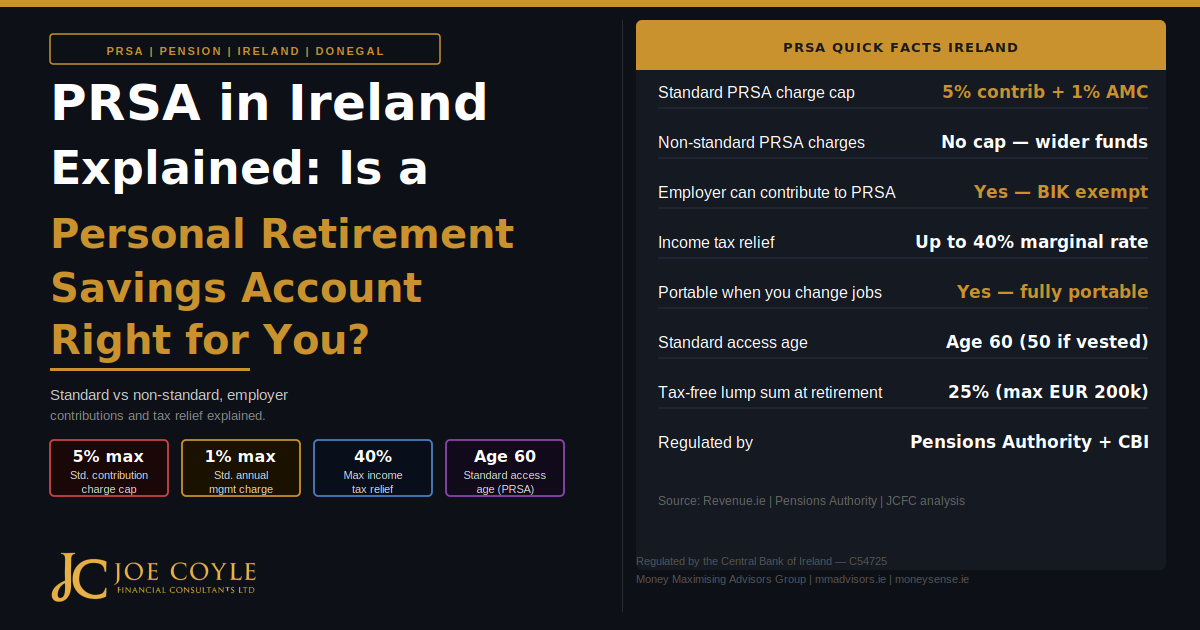
For Defined Contribution (DC) occupational pension members, Personal Retirement Savings Accounts (PRSAs) and Personal Retirement Bonds (PRBs), the standard tax-free entitlement is 25% of the total fund value at retirement, subject to the EUR 200,000 lifetime cap.
How the 25% Rule Works in Practice
Pension fund of EUR 400,000: 25% = EUR 100,000 tax-free. Well within the EUR 200,000 cap.
Pension fund of EUR 800,000: 25% = EUR 200,000 tax-free. Exactly hits the cap, maximum tax-free amount.
Pension fund of EUR 1,200,000: 25% = EUR 300,000, but only EUR 200,000 is tax-free. The next EUR 100,000 is taxed at 20%.
💡 To take the full EUR 200,000 tax-free under the 25% rule, you need a pension fund of at least EUR 800,000. If your fund is below this amount, you will not reach the lifetime cap and all of your 25% lump sum is tax-free.
► Calculate Your Exact Tax-Free Lump Sum Entitlement, Book a Free Retirement Consultation
Method 2: The Salary-and-Service Formula (Occupational Pension Members)
Members of occupational (employer) pension schemes have access to a potentially more generous calculation method based on their final salary and years of service. The formula is:
(Final Salary ÷ 15) × Years of Service = Maximum Tax-Free Lump Sum
This formula can produce a higher tax-free lump sum than the 25% rule, particularly for long-service employees. You are entitled to use whichever calculation gives you the higher amount.
Worked Example: Salary-and-Service Formula
Final salary: EUR 70,000
Years of service: 30 years
Formula: EUR 70,000 ÷ 15 × 30 = EUR 140,000 tax-free
25% rule on same fund (EUR 700,000): EUR 175,000 tax-free, in this case the 25% rule is better
Now consider someone with a higher salary and longer service:
Final salary: EUR 90,000
Years of service: 40 years
Formula: EUR 90,000 ÷ 15 × 40 = EUR 240,000, BUT capped at EUR 200,000 lifetime limit
Even in this case, the formula outperforms the 25% rule (which on a EUR 800,000 fund gives EUR 200,000). The key point is that the salary-and-service formula can produce a higher figure and is worth calculating separately, particularly for senior employees with long tenure in a DB or hybrid scheme.
Can I Take My Pension Lump Sum at 50 in Ireland?
Yes, in certain circumstances, you can access a tax-free lump sum from your pension from age 50. This is a significant benefit of the Irish system that many people are not aware of, and Joe Coyle Financial Consultants regularly helps clients in Donegal and nationwide structure early lump sum access.
Which Pensions Allow Access from Age 50?
Personal Retirement Bond (PRB): Access from age 50, the most common vehicle for early access. If you have left employment and transferred to a PRB, you can take your 25% tax-free from age 50.
Occupational pension scheme (former employer): If you have left the employment associated with the scheme, deferred members can typically access benefits from age 50 subject to scheme rules.
Vested PRSA: A PRSA that has been linked to a former employment and then vested can be accessed from age 50.
Standard PRSA (current or without employment link): Normal access age is 60, not 50.
Personal pension (RAC) not linked to employment: Normal access age is 60, not 50.
⚠️ Important: Taking your pension lump sum at 50 depletes your fund earlier, reducing the amount available for ARF drawdown and annual income in later retirement. Always model the long-term impact on retirement income before taking early access, particularly if you have no other significant income source in retirement.
► Find Out If You Can Access Your Pension From Age 50, Book a Free Review
Should I Take the Maximum Tax-Free Lump Sum?
For most Irish retirees, taking the full 25% (or the maximum available) as a tax-free lump sum is the right decision, because money taken tax-free today is always more valuable than the same amount remaining in the fund subject to future income tax through ARF withdrawals. However, the decision is not universal.
Reasons to Take the Maximum Tax-Free Lump Sum
Immediate tax efficiency: Money taken tax-free now avoids income tax, USC and PRSI on future ARF withdrawals at the 40% rate
Mortgage or debt clearance: Using the lump sum to clear a mortgage or high-interest debt saves ongoing interest costs
Inheritance planning: Assets outside a pension can be more flexibly structured for inheritance than ARF residual funds
Capital investment: Investing the lump sum in assets outside the pension, property, shares, diversifies your retirement income sources
Reasons You Might Not Take the Maximum
Income needs are met by other sources: If you have substantial rental income, part-time earnings or a defined benefit pension, you may not need the ARF income and should preserve the fund for compounding
Fund is very small: On a EUR 100,000 fund, taking EUR 25,000 tax-free leaves only EUR 75,000 in the ARF, potentially insufficient for meaningful drawdown income
What Should I Do With My Pension Lump Sum?
The pension lump sum is a one-off, tax-privileged event. How you use it matters significantly for your long-term financial position. Joe Coyle Financial Consultants reviews lump sum deployment as part of every retirement planning consultation.
Clear the mortgage: If your mortgage has an outstanding balance at retirement, clearing it with the lump sum eliminates a major monthly outgoing and improves cash flow significantly
Invest in State Savings or deposits: An Post State Savings products offer tax-free returns for Irish residents on qualifying amounts, suitable for the conservative portion of a lump sum
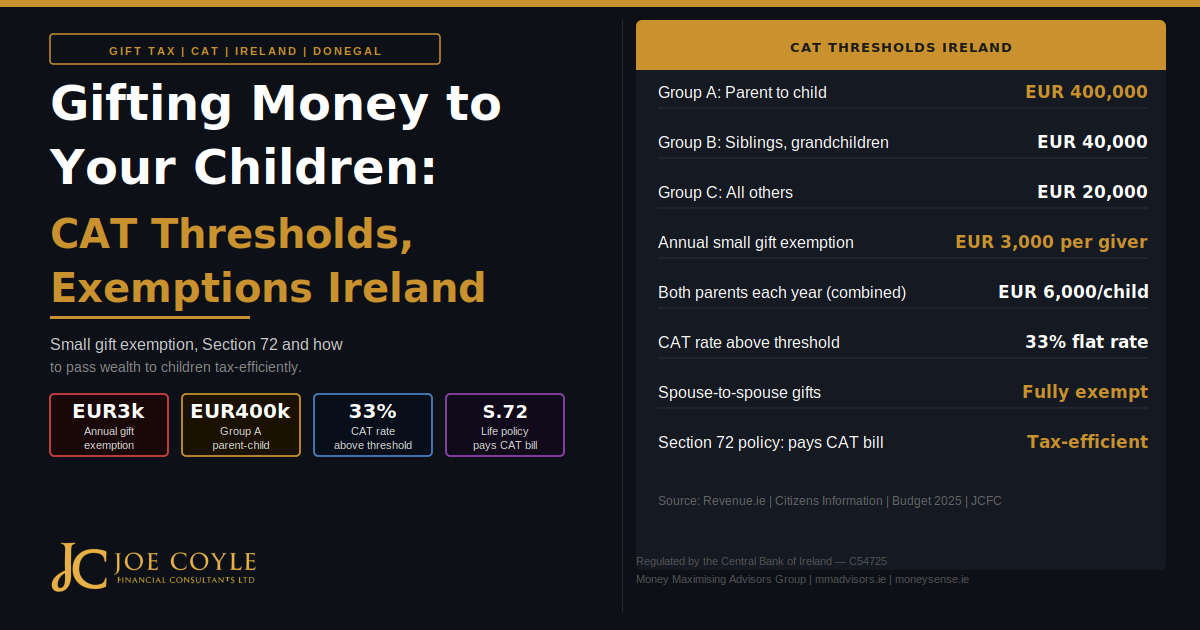
Contribute to a child’s deposit: A lump sum gift to a child saving for a house, structured within the EUR 3,000 annual small gift exemption and the EUR 400,000 Group A CAT threshold, can transfer significant wealth tax-efficiently
Home improvement or adaptation: Invest in your home, energy efficiency, accessibility improvements, or a primary residence upgrade, as the value returned may exceed the cost over time
Diversified investment: For those with sufficient retirement income from other sources, investing the lump sum in a diversified portfolio provides continued long-term growth outside the pension wrapper
Frequently Asked Questions: Pension Tax-Free Lump Sum Ireland
How much of my pension can I take tax-free in Ireland?
Up to 25% of your total pension fund, subject to a lifetime cap of EUR 200,000. The cap is cumulative across all your pension arrangements, not per pension pot. The next EUR 300,000 (EUR 200,001 to EUR 500,000) is taxed at 20%, and amounts above EUR 500,000 are taxed at your marginal income tax rate.
What is the maximum tax-free lump sum in Ireland?
EUR 200,000, this is the lifetime maximum that any individual can take tax-free across all their pension arrangements. To take the full EUR 200,000 under the 25% rule, you need a pension fund of at least EUR 800,000. Occupational scheme members may be entitled to a higher amount under the salary-and-service formula, but the EUR 200,000 tax-free cap still applies.
How is a pension lump sum over EUR 200,000 taxed in Ireland?
The next EUR 300,000 above the tax-free limit (EUR 200,001 to EUR 500,000) is taxed at the standard income tax rate of 20%, with no USC or PRSI. Amounts above EUR 500,000 are taxed at your marginal rate (typically 40%) and may attract USC. This applies to the total lump sum taken across all your pension arrangements over your lifetime.
When can I take my tax-free lump sum from my pension?
The access age depends on your pension type. Personal Retirement Bonds (PRBs) and deferred occupational pensions allow access from age 50 (if you have left that employment). Standard PRSAs and personal pensions (RACs) are accessible from age 60. Current employer schemes are accessible at the scheme’s retirement age, typically 60 or 65.
Should I take the maximum tax-free lump sum from my pension?
For most Irish retirees, yes, taking the full tax-free amount is efficient because it converts a future taxable ARF withdrawal into a tax-free event today. However, the decision depends on your other income sources, mortgage position, estate planning goals, and whether you need the ARF income for ongoing living costs. Joe Coyle Financial Consultants models both scenarios for every client.
What should I do with my pension lump sum?
Common and tax-efficient uses include: clearing a mortgage or outstanding debt; investing in State Savings or An Post products (tax-free for qualifying Irish residents); structured gifting to children within CAT thresholds; home improvement or adaptation; and diversified investment outside the pension wrapper. Joe Coyle Financial Consultants advises on the optimal deployment strategy for your personal circumstances.
Plan Your Pension Lump Sum Strategy, Book a Free Retirement Consultation
Important Information
This article is for general information only and does not constitute financial or legal advice. Pension lump sum tax rule and retirement income information is correct at the date of publication and may change. Joe Coyle Financial Consultants Ltd is regulated by the Central Bank of Ireland (C54725), part of the Money Maximising Advisors group (C154250). Always seek personalised advice from a Qualified Financial Advisor before making financial decisions.