Can I retire at 55 in Ireland? Yes, retiring at 55 in Ireland is achievable, but it requires specific conditions and careful planning. The key challenge is that the State Pension does not pay until age 66, leaving an 11-year gap you must fund entirely from private sources. For pension access: Personal Retirement Bonds (PRBs) and deferred occupational pensions allow access from age 50; standard PRSAs and RACs from age 60; and public sector employees may qualify for cost-neutral early retirement from age 55. The typical private pension fund needed to retire at 55 on EUR 35,000 per year of income is approximately EUR 875,000 to EUR 1,000,000, before accounting for the State Pension which supplements income from age 66 onwards.
Joe Coyle Financial Consultants, a CBI-regulated financial broker based in Donegal and part of the Money Maximising Advisors group, helps clients plan and execute early retirement across Ireland. Our retirement planning advice Ireland service includes comprehensive early retirement modelling, calculating the exact fund needed, structuring the most tax-efficient drawdown, and bridging the 11-year gap to the State Pension. Further guidance at Money Sense Financial Services.
Retiring at 55 is one of the most common financial goals Joe Coyle Financial Consultants hears from clients in Donegal and across Ireland. It is an attractive, achievable goal for many people, but it requires a fundamentally different planning approach than retiring at 65. This guide provides the complete picture: the pension access rules that apply at 55, the fund sizes you actually need, the tax-efficient drawdown strategy, and the specific bridge plan for the 11-year gap to the State Pension.
The Single Biggest Challenge of Retiring at 55 in Ireland: The State Pension Gap
The Irish State Pension (Contributory) is payable from age 66, not 55. If you retire at 55, you face an 11-year period during which you must fund your entire lifestyle from private pension savings, personal investments, or other income sources. The State Pension, at EUR 299.30 per week (EUR 15,564 per year) in the current year, provides a meaningful supplement from age 66, but it is not available for that critical 11-year gap.
This has several important implications for early retirement planning:
Your fund must be larger: You are drawing income from the fund for 11 extra years before the State Pension reduces the annual withdrawal requirement
Your fund must sustain higher withdrawals in early years: Before the State Pension begins at 66, 100% of your income comes from private sources, after 66, the State Pension supplements this, reducing the required annual drawdown
Investment risk management is more complex: With a longer time horizon from 55, you need a drawdown strategy that balances growth with capital preservation across potentially 30+ years
💡 Many Irish people assume the State Pension is part of their early retirement income from day one. It is not. Retiring at 55 means 11 years entirely without State Pension. This is the fundamental number that drives the fund size required and the strategy needed. Joe Coyle Financial Consultants builds a two-phase income model for every early retirement client: Phase 1 (age 55 to 66, fully self-funded) and Phase 2 (age 66+, State Pension supplements private income).
► Model Your Early Retirement Plan, Book a Free Consultation with Joe Coyle Financial Consultants
Can I Access My Pension at 55 in Ireland? The Rules by Pension Type
Pension access rules in Ireland vary significantly by pension type. Here is a clear breakdown of what is accessible at age 55:
Personal Retirement Bond (PRB), Access from Age 50 ✅
A Personal Retirement Bond (also called a Buy Out Bond) is the most common vehicle for early pension access in Ireland. If you have left employment associated with the pension and the transfer value has been placed in a PRB, you can access it from age 50. At 55, you are well within the access window.
Access age: 50, so fully accessible at 55
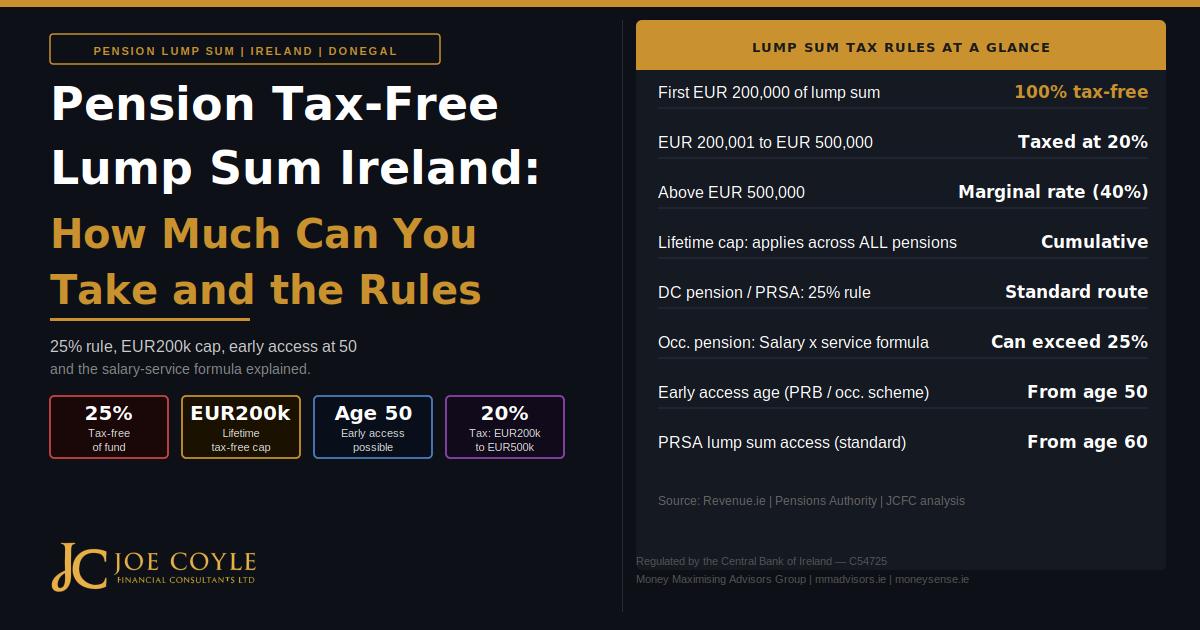
Tax-free lump sum: 25% of the fund value, up to EUR 200,000 lifetime limit
Remainder: Invested in an Approved Retirement Fund (ARF) or used to purchase an annuity
Condition: You must have left the employment linked to the original occupational scheme
Deferred Occupational Pension (Former Employer), Access from Age 50 ✅
If you are a member of a deferred occupational pension scheme, a pension linked to a former employer where you have already left that employment, access is typically available from age 50 subject to the scheme rules. Most schemes allow it; some require trustee approval. At 55, this is generally straightforward.
Executive Pension (Company Director), Access from Age 50 ✅
Company directors with an executive pension (also called a Director’s Pension or company-sponsored pension) can typically access it from age 50 if they have left service or wound up the company. This makes the executive pension one of the most powerful tools for early retirement planning for Irish business owners.
Standard PRSA, Age 60 Required ❌ (unless Vested)
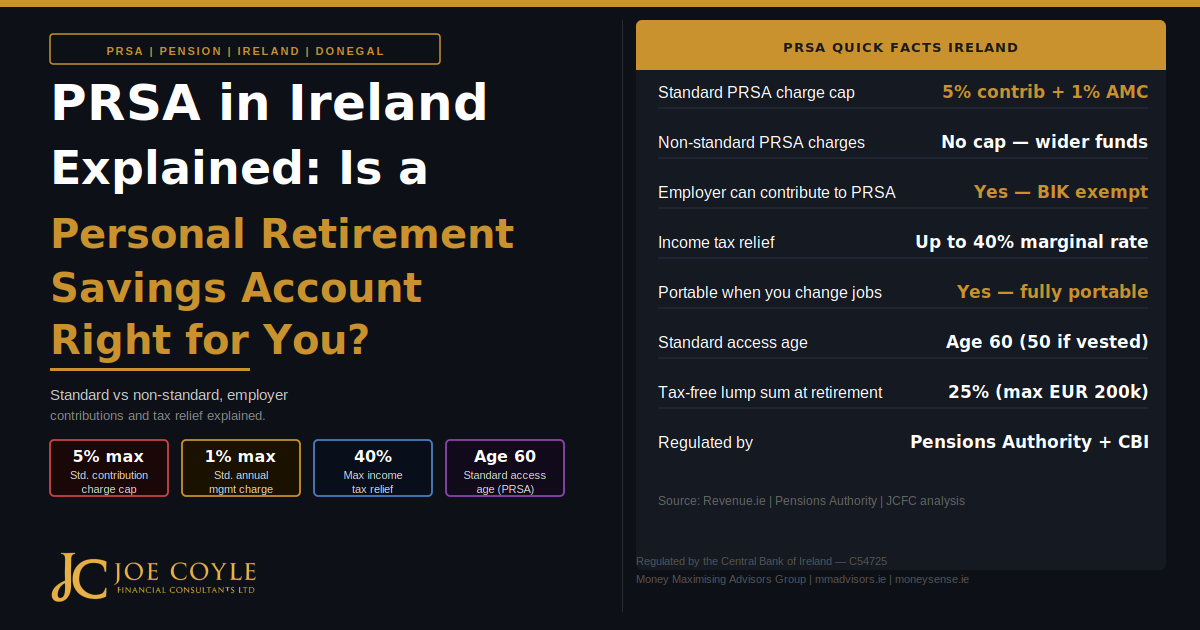
A standard PRSA not linked to a specific former employer has a normal access age of 60, not 50. You cannot access a standard PRSA at 55 unless it has been designated as a Vested PRSA through a former employment link.
Exception, Vested PRSA: If a PRSA was linked to a former employer who contributed to it, and that employment has ended, the PRSA can be vested and accessed from age 50
Planning implication: Anyone planning to retire at 55 should structure their pension contributions into a vehicle accessible from age 50, not a standard PRSA. Joe Coyle Financial Consultants reviews pension structures well in advance of target retirement dates to ensure the right vehicle is in place
Personal Pension / RAC, Age 60 Required ❌
A Retirement Annuity Contract (RAC), the traditional personal pension for self-employed individuals, has a minimum access age of 60. Not accessible at 55 in normal circumstances.
Public Sector Pension, Early Retirement from Age 55 ✅ (Cost-Neutral Basis)
Many public servants who joined the public service before certain cutoff dates qualify for cost-neutral early retirement from age 55. The pension is reduced by an actuarial factor to reflect the longer payment period, but no consent from the employer is required and the pension is available immediately at 55. This is one of the most valuable aspects of the public sector pension system that many workers do not fully appreciate.
| Pension Type | Access Age | Notes |
| Personal Retirement Bond (PRB) | Age 50 | Must have left associated employment |
| Deferred Occupational Pension | Age 50 (scheme rules) | Trustee approval may be required |
| Executive Pension (Director) | Age 50 | Must have left service / wound up company |
| Standard PRSA (no employment link) | Age 60 | Cannot be accessed at 55 |
| Vested PRSA (former employer link) | Age 50 | Employment must have ended |
| Personal Pension / RAC | Age 60 | Not accessible at 55 |
| Public Sector (pre-cutoff) | Age 55 (cost-neutral) | Actuarial reduction applies |
⚠️ Important: If you are planning to retire at 55 and your pension is currently in a standard PRSA or RAC, you cannot access it at 55. You need to restructure into a PRB or occupational scheme now, ideally at least several years before your target retirement date. Joe Coyle Financial Consultants reviews and restructures pension arrangements for early retirement planning as a core service.
How Much Do I Need to Retire at 55 in Ireland? The Real Numbers
This is the question every early retirement planner needs answered with real numbers, not generic guidance. The fund required depends on three variables: the income you want in retirement, the gap years before the State Pension, and your expected drawdown rate. Here is a practical framework.
The Two-Phase Retirement Income Model
A retire-at-55 plan works in two distinct phases:
Phase 1: Age 55 to 66 (11 years): 100% of retirement income must come from your private pension and savings. The annual drawdown is higher in this phase because there is no State Pension supplement.
Phase 2: Age 66 onwards: The State Pension (currently EUR 15,564 per year) supplements your income, meaning you need to draw less from the ARF each year, and the fund is preserved for longer.
Fund Size Calculations by Target Income
Using a 4% safe drawdown rate (the standard planning assumption for ARF sustainability over a 30+ year retirement), here are the fund sizes required for different income targets:
| Target Annual Income | Phase 1 Drawdown (age 55-66) | Phase 2 ARF (after State Pension) | Approx. Fund Required at 55 |
| EUR 25,000 per year | EUR 25,000 from ARF | EUR 9,436 from ARF | EUR 625,000 to EUR 700,000 |
| EUR 35,000 per year | EUR 35,000 from ARF | EUR 19,436 from ARF | EUR 875,000 to EUR 950,000 |
| EUR 50,000 per year | EUR 50,000 from ARF | EUR 34,436 from ARF | EUR 1,250,000 to EUR 1,350,000 |
| EUR 70,000 per year | EUR 70,000 from ARF | EUR 54,436 from ARF | EUR 1,750,000+ |
These are illustrative estimates based on the 4% drawdown rule, assuming the State Pension of approximately EUR 15,564 per year from age 66 and a 5% average ARF growth rate. Actual fund requirements depend on your specific tax position, other income sources, investment returns, inflation, healthcare costs and longevity assumptions. Joe Coyle Financial Consultants builds a personalised retirement income model for every client with real numbers.
💡 The 4% rule means you can draw EUR 4 from every EUR 100 in your ARF each year with a high statistical probability of not depleting the fund over a 30-year retirement. On a EUR 1,000,000 ARF, this is EUR 40,000 per year, a sustainable income that allows the fund to continue growing at moderate investment returns. Once the State Pension adds EUR 15,564 from age 66, you only need to draw EUR 24,436 from the ARF, dramatically reducing the depletion rate and extending the fund’s lifespan.
► Get Your Personal Early Retirement Number, Book a Free Consultation
The 11-Year Bridge Strategy: How to Fund the Gap to the State Pension
The 11-year gap between retiring at 55 and the State Pension at 66 is the defining challenge of early retirement planning in Ireland. Here is how to structure the bridge:
Strategy 1: Build the ARF to Cover Phase 1 Fully
The most straightforward approach: accumulate a large enough ARF that Phase 1 drawdowns (55 to 66) at your target income do not deplete the fund below the level needed for sustainable Phase 2 income. This requires a larger fund, but offers the most flexibility and simplest management.
Strategy 2: Use the Tax-Free Lump Sum to Create a Dedicated Bridge Fund
At age 55, take your 25% tax-free lump sum (up to EUR 200,000) and invest it separately, not in the ARF, as a dedicated bridge income for years 55 to 66. Invest in An Post State Savings, deposits, or a laddered bond portfolio designed to pay out a fixed amount each year for 11 years. The ARF is then left largely undisturbed during Phase 1, allowing it to continue growing and compound before you begin drawing from it more heavily in Phase 2.
Example: EUR 200,000 in a State Savings product paying EUR 18,182 per year for 11 years fully covers the State Pension gap, and the ARF, left intact from age 55 to 66, continues growing throughout Phase 1.
Strategy 3: Part-Time Work During Phase 1 (Semi-Retirement)
Many people who ‘retire at 55’ do not fully stop earning, they step back from full-time employment into consultancy, part-time work, portfolio careers, or business interests that generate modest income. Even EUR 10,000 to EUR 15,000 per year in Phase 1 income significantly reduces the ARF drawdown requirement, extends the fund’s life, and makes the numbers work more easily on a smaller accumulated fund.
Important rule: You generally only need to leave the specific employment linked to your occupational pension. Retiring from a salaried position and continuing to do consultancy work does not prevent you from accessing a pension linked to that former employment.
Strategy 4: Voluntary PRSI Contributions to Protect the State Pension
If you retire at 55 and stop paying PRSI, you risk having insufficient contributions for the full State Pension at 66. Between age 55 and 66, you can make Voluntary PRSI contributions to protect your State Pension entitlement. The cost depends on your income level but is generally modest relative to the lifetime value of a full State Pension. Joe Coyle Financial Consultants reviews your PRSI record as part of every early retirement consultation.
The Tax Treatment of Early Retirement Income in Ireland
Phase 1: Age 55 to 61 (Before Imputed Distribution Kicks In)
Between ages 55 and 60, you are in full control of ARF withdrawals. You take exactly as much as you need and pay income tax, USC and potentially PRSI at your normal marginal rate on the withdrawal. There is no minimum annual withdrawal requirement in this phase, you can take nothing from the ARF in a given year if other income sources cover your needs, and the ARF grows tax-free inside the wrapper.
Age 61 Onwards: The Imputed Distribution
From the year you turn 61, Revenue requires a minimum annual withdrawal from the ARF, the imputed distribution, whether you need the money or not:
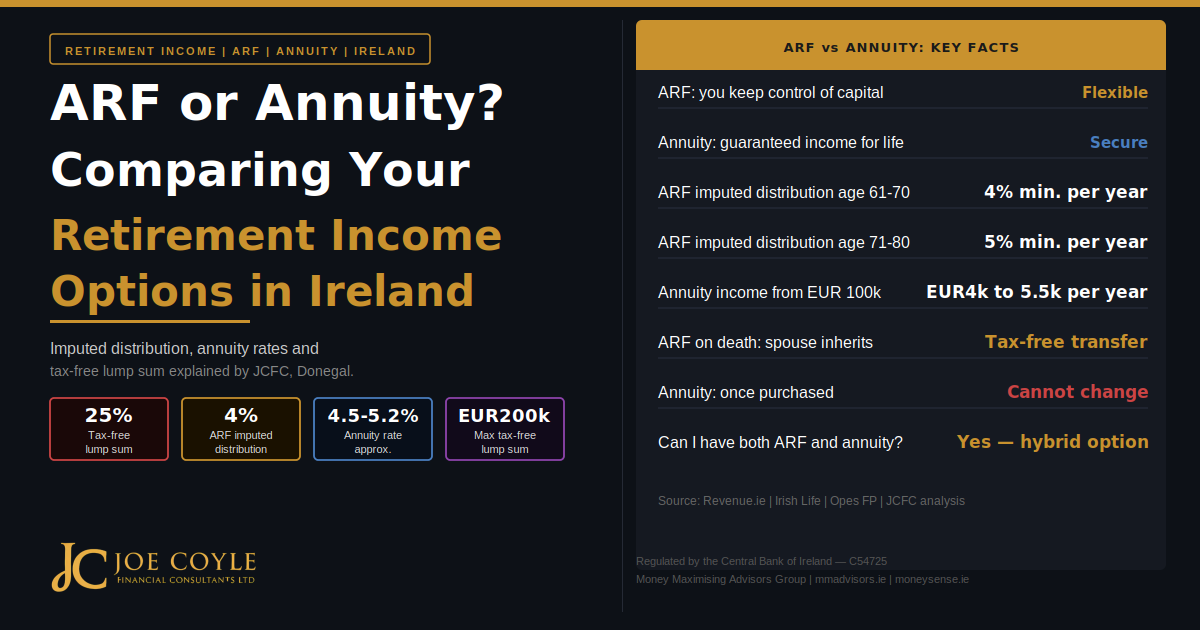
Age 61 to 70: 4% of ARF value per year minimum
Age 71 to 80: 5% of ARF value per year minimum
Age 81 and over: 6% of ARF value per year minimum
ARF value over EUR 2 million: 6% from any age
The imputed distribution is taxed as income. If you do not physically withdraw it, Revenue will still charge you income tax on the imputed amount. For early retirees whose Phase 1 ARF drawdowns are already at or above 4%, the imputed distribution rules add no additional burden, the required minimum and actual withdrawal are already aligned.
Managing Your Tax Position in Retirement
A key advantage of early retirement at 55 is that income tax management becomes highly flexible. With no employment income, you can manage ARF withdrawals carefully to stay within the standard rate band (EUR 42,000 for a single person), keeping income tax at 20% rather than 40%. Once the State Pension begins at 66, the combined income position shifts and must be re-modelled. Joe Coyle Financial Consultants provides ongoing retirement income tax planning as part of the retirement management service.
► Plan Your Retirement Tax Strategy, Book a Free Retirement Consultation
Early Retirement at 55: Practical Profiles
Profile 1: The Private Sector Employee
A 55-year-old Donegal professional with 25 years in the same company has an occupational pension scheme. They have left employment and the pension has been transferred to a PRB. Fund value: EUR 900,000. They take EUR 200,000 as a tax-free lump sum, leaving EUR 700,000 in an ARF. They draw EUR 30,000 per year from the ARF (4.3%), supplemented by EUR 200,000 invested in State Savings paying EUR 18,000 per year for 11 years, giving EUR 48,000 per year total income in Phase 1. From age 66, the State Pension adds EUR 15,564, and they reduce the ARF drawdown to EUR 20,000, improving fund sustainability significantly.
Profile 2: The Company Director
A 55-year-old business owner winds up their company and accesses their executive pension. Fund value: EUR 1,400,000. Takes EUR 200,000 tax-free lump sum. Invests EUR 1,200,000 in an ARF with Joe Coyle Financial Consultants managing the investment strategy. Draws EUR 50,000 per year in Phase 1 (4.2% of fund), fully covering living expenses with income tax managed within the standard rate band. From age 66, State Pension supplements income and ARF drawdown falls to EUR 35,000 per year, significantly improving fund sustainability into their 80s.
Profile 3: The Public Sector Worker
A public servant who joined before the 2004 cutoff date qualifies for cost-neutral early retirement at 55. They receive an immediate defined benefit pension, reduced by the actuarial factor, plus a tax-free lump sum. The defined benefit pension provides guaranteed income for life without the investment risk of an ARF. From age 66, the State Pension supplements the DB pension, creating a very secure two-income retirement. The main planning challenge for public sector early retirees is managing the tax position across both income streams efficiently.
Steps to Take Now If You Want to Retire at 55
The most critical insight from working with early retirement clients: the decisions that make or break a retire-at-55 plan are taken 5 to 10 years before the target date, not in the year of retirement. Here is what to do:
- Get a pension access audit: Confirm which of your pension vehicles are accessible from age 50 or 55, and which require restructuring. This is the single most important first step, if your pension is in a vehicle inaccessible at 55, you need to restructure now.
- Calculate your target fund number: Work with Joe Coyle Financial Consultants to model the exact fund size needed for your target income level, using the two-phase model and your specific PRSI record and State Pension entitlement.
- Maximise contributions in the years before retirement: From age 55 to 59, Revenue allows 35% of earnings in pension contributions with full income tax relief, the highest contribution window after age 60. Use this fully in the 5 years before your target date.
- Review your PRSI record: Request a statement of contributions from the Department of Social Protection at mywelfare.ie. If you have gaps, assess whether Voluntary PRSI contributions before retirement are worthwhile.
- Plan your bridge strategy: Decide how you will fund the 11-year gap to the State Pension, full ARF drawdown, lump sum bridge fund, part-time work, or a combination.
- Structure the drawdown for tax efficiency: Plan your annual withdrawals to optimise the income tax position, staying within the standard rate band where possible, managing the ARF and other income sources as a combined picture.
Frequently Asked Questions: Early Retirement Ireland
Can I retire at 55 in Ireland?
Yes, if your pension is in a vehicle accessible from age 50 (such as a PRB or deferred occupational scheme) and you have accumulated a sufficient fund. The key challenge is the 11-year gap to the State Pension at 66, which must be funded entirely from private sources. With the right fund size and bridge strategy, retiring at 55 is achievable and is a goal Joe Coyle Financial Consultants has helped many Donegal and nationwide clients achieve.
How much do I need to retire at 55 in Ireland?
The required fund depends on your target income. At a 4% drawdown rate, retiring at 55 on EUR 35,000 per year requires approximately EUR 875,000 to EUR 950,000 in pension and investment assets. For EUR 50,000 per year, approximately EUR 1,250,000 to EUR 1,350,000. These figures reduce from age 66 when the State Pension (approximately EUR 15,564 per year) supplements private income. Joe Coyle Financial Consultants models your personal early retirement number at the first free consultation.
What is the earliest age I can access my pension in Ireland?
Age 50 for Personal Retirement Bonds (PRBs), deferred occupational pensions, and vested PRSAs, provided you have left the associated employment. Age 55 for public sector cost-neutral early retirement (for those who joined before certain cutoff dates). Age 60 for standard PRSAs and personal pensions (RACs). Age 66 for the State Pension (Contributory).
How do I bridge the gap to the State Pension if I retire at 55?
The most effective strategies are: (1) build an ARF large enough to sustain Phase 1 drawdowns without depleting the fund; (2) invest the tax-free lump sum (up to EUR 200,000) in dedicated bridge assets such as An Post State Savings paying fixed income for 11 years; (3) supplement with part-time or consultancy income in Phase 1; and (4) make voluntary PRSI contributions to protect State Pension entitlement. Joe Coyle Financial Consultants designs the optimal bridge strategy for your specific fund, income needs and lifestyle goals.
Can I retire at 55 and still work part-time in Ireland?
Yes, and this is one of the most popular and practical approaches to early retirement in Ireland. You generally only need to leave the specific employment linked to your occupational pension to access it from age 50. You can then take on part-time work, consultancy, or a different employment without affecting your pension access. Even modest Phase 1 income of EUR 10,000 to EUR 15,000 per year significantly reduces the ARF drawdown requirement and extends the fund’s life.
What happens to my PRSI record if I retire at 55?
Retiring at 55 stops PRSI contributions unless you continue to have employment or self-employment income. If you have insufficient contributions for the full State Pension (2,080 paid contributions), you can make Voluntary PRSI contributions to protect your entitlement. Joe Coyle Financial Consultants reviews your PRSI record as part of every early retirement consultation, the long-term value of the full State Pension (EUR 15,564 per year for life from age 66) makes protecting this entitlement a high-priority planning decision.
How does tax work if I retire early in Ireland?
ARF withdrawals are taxed as income, subject to income tax, USC and (before age 66) PRSI. The imputed distribution rule requires a minimum 4% annual withdrawal from age 61. A major advantage of early retirement is the ability to manage annual withdrawals to stay within the standard rate band (EUR 42,000 for a single person), keeping income tax at 20% rather than 40%. Once the State Pension begins at 66, the combined income position must be re-modelled. Joe Coyle Financial Consultants provides ongoing retirement income tax planning for early retirees.
► Plan Your Early Retirement at 55, Book a Free Consultation with Joe Coyle Financial Consultants
Important Information
This article is for general information only and does not constitute financial advice. Pension access rules, retirement income figures and tax rules are correct at the date of publication and may change. Joe Coyle Financial Consultants Ltd is regulated by the Central Bank of Ireland (C54725), part of the Money Maximising Advisors group (C154250). Always seek personalised advice from a Qualified Financial Advisor before making retirement decisions.