What should I do after being made redundant in Ireland?
After redundancy in Ireland: (1) register for Jobseeker’s Benefit at Intreo or MyWelfare.ie immediately; (2) verify your statutory redundancy payment has been calculated correctly; (3) get your pension options reviewed by a qualified advisor before making any decisions; (4) explore free retraining through Springboard+, Skills Connect or eCollege, you can keep Jobseeker’s Benefit while studying most part-time courses; and (5) book a free redundancy consultation with Joe Coyle Financial Consultants to plan your next financial step.
Joe Coyle Financial Consultants, a CBI-regulated financial broker in Donegal, part of the Money Maximising Advisors group, provides specialist redundancy advice Ireland covering the financial settlement, pension decisions and the full transition to new employment or retraining. See also Money Sense Financial Services.
Redundancy in Ireland is increasingly common, particularly following restructurings in technology, retail, financial services and manufacturing. For many people it arrives with little warning and brings immediate financial anxiety. But redundancy is also frequently the catalyst for a career pivot, further education, or a significant improvement in work-life balance. This guide covers every practical step: immediate financial actions, free retraining supports, how to maintain income during a course, and how to plan your next career move strategically.
Immediate Financial Steps After Redundancy in Ireland
Step 1: Verify Your Redundancy Payment
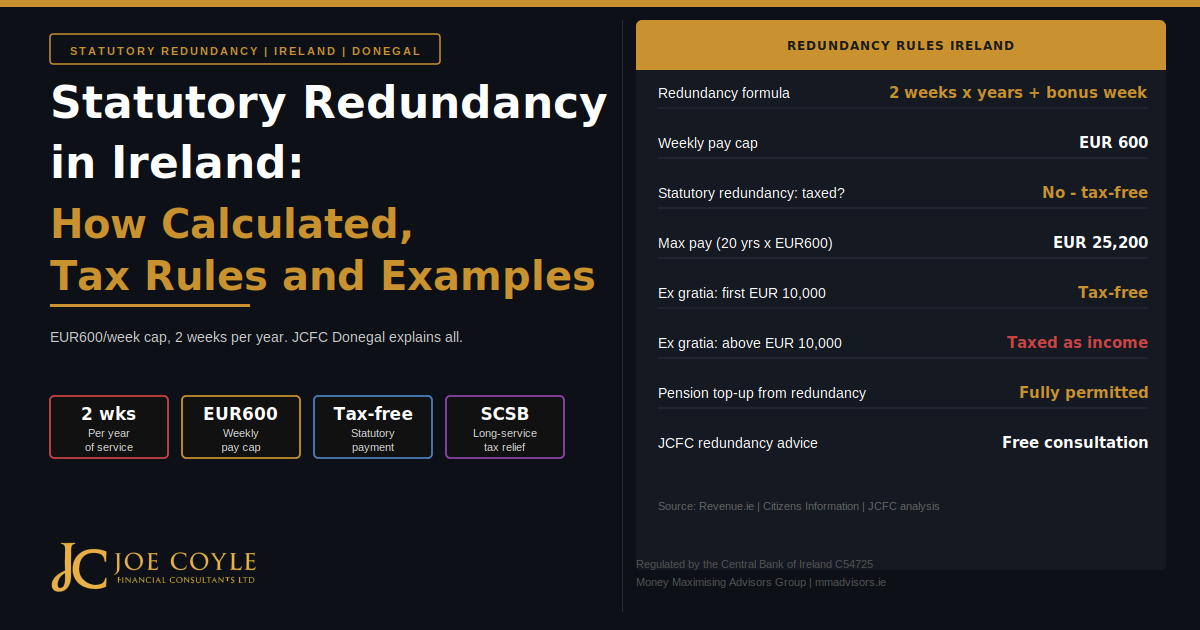
Your statutory entitlement is 2 weeks’ pay per complete year of service plus 1 bonus week, capped at €600 per week, 100% tax-free. If your employer offers an enhanced ex-gratia payment, that additional sum may be partially tax-exempt under the Basic Exemption (€10,160 + €765 per year), the Increased Exemption (+€10,000), or the SCSB formula. Joe Coyle Financial Consultants reviews your specific package to ensure you are maximising every available tax-free entitlement.
Step 2: Register for Jobseeker’s Benefit Immediately
Apply at your local Intreo centre or online at MyWelfare.ie as soon as possible after your last day. Your entitlement does not start until your claim is registered. The maximum Jobseeker’s Benefit rate is approximately €220 per week (higher with dependants) and is payable for up to 9 months if you have sufficient PRSI contributions.
Step 3: Review Your Pension Before Doing Anything With It
One of the most consequential decisions following redundancy is what to do with your occupational pension. Your options are: leave it in the existing scheme as a deferred benefit; transfer it to a Personal Retirement Bond (PRB) in your own name; or transfer to a new employer’s scheme. The wrong choice here can cost tens of thousands of euros in reduced retirement income. Joe Coyle Financial Consultants reviews this for every redundancy client.
► Get Your Redundancy Package and Pension Reviewed Before You Sign Anything
Every Free and Subsidised Retraining Programme Available in Ireland
1. Springboard+, Free Higher Education Courses
Springboard+ provides free higher education places for unemployed adults at NFQ Levels 6 to 9, from Certificate through to Master’s level, across technology, healthcare, business, sustainability and more.
Who qualifies: Unemployed people (including those on Jobseeker’s Benefit or Allowance), people returning after a career break, and home-makers
Cost: Free for unemployed participants. Employed participants pay approximately 10% of course cost for NFQ Level 7+ courses
Format: Predominantly part-time and flexible
Where to find courses: springboardcourses.ie, searchable by subject, location and NFQ level
2. Skills Connect, Free Short Courses with Work Placement
Skills Connect offers free shorter training courses of 2–12 weeks targeted at people who have lost their job. Courses may include work placements and focus on digital, green economy, logistics, hospitality, construction and manufacturing sectors. Available at gov.ie/skillsconnect.
3. eCollege, Free Online Learning Any Time
eCollege is a Government-funded online platform with hundreds of free courses available 24/7 covering IT, project management, digital marketing, business administration and more. Self-paced and suitable for upskilling while job-seeking. Access at ecollege.ie.
4. Skillnet Ireland, Subsidised Industry Training
Over 60 Skillnet networks across Ireland co-fund training in sectors from agri-food and construction to financial services and creative industries. Subsidised rates are typically 50–70% below commercial costs. Find networks at skillnetireland.ie.
5. BTEI, Back to Education Initiative
The BTEI provides part-time adult literacy, numeracy and second-chance education for adults who want to improve basic skills or complete a Leaving Certificate equivalent. Delivered through Education and Training Boards (ETBs) across all counties.
6. Apprenticeships, Earn While You Learn
Ireland now covers over 60 trades and programmes across craft, technology, healthcare and business. Apprenticeships combine on-the-job training with classroom learning, you earn a wage from day one. Areas include accounting technician, electrical instrumentation, auctioneering and insurance practitioner. Find programmes at apprenticeship.ie.
7. Post-Leaving Certificate (PLC) Courses
Full-time programmes at NFQ Levels 5 and 6, typically one year duration. Almost 30,000 places annually across every county. Courses start in September and cover early childhood education, IT, engineering, media and more.
Can I Keep Jobseeker’s Benefit While Retraining in Ireland?
Usually yes, for certain types of courses.
Back to Education Allowance (BTEA)
BTEA allows people on qualifying social welfare payments (including Jobseeker’s Benefit) to pursue approved full-time second or third-level education while retaining their payment. You must typically be unemployed for a minimum period (3–9 months depending on circumstances). BTEA is paid at the same rate as Jobseeker’s Benefit and replaces it during studies.
Part-Time Courses: Jobseeker’s Benefit Usually Retained
For part-time courses (most Springboard+, Skills Connect, eCollege options), you can typically remain on Jobseeker’s Benefit as long as you continue to be available for and actively seeking full-time work. Always notify your Intreo case officer before starting any course.
💡 Many Intreo case officers actively encourage clients to start Springboard+ or Skills Connect during their Jobseeker’s Benefit period. The supports work together, you retrain for free while keeping your social welfare payment.
► Get Your Financial Position Planned Around a Retraining Decision, Book a Free Consultation
Managing Your Money During Retraining
Monthly cashflow during retraining: Income from Jobseeker’s Benefit, BTEA or part-time work vs essential outgoings, ensuring the household budget is sustainable for the full course duration
Protecting your pension: Continue pension contributions where possible during retraining. Contributions to a PRSA remain possible with even modest earnings.
Income protection insurance: If you had income protection through your employer, it typically ceases on redundancy. Consider independent cover once re-employed, particularly if you move into self-employment.
Emergency fund priority: Your redundancy lump sum should first bolster your emergency fund to cover the full retraining period before any other allocation.
Choosing Your Career Pivot: In-Demand Sectors in Ireland
Technology and digital: Software development, data analysis, cybersecurity, cloud computing, digital marketing, highest-paying and fastest-growing employment sectors in Ireland. Strong free retraining routes through Springboard+ and eCollege.
Healthcare and social care: Nursing, healthcare support, early childhood care, significant growing demand across all counties with guaranteed public sector employment pathways in many roles
Green economy and construction: The Government’s housing targets and climate action commitments drive sustained demand for skilled workers in retrofitting, renewable energy and sustainability roles. ETB-delivered apprenticeships provide direct entry routes.
Financial services: Accounting, compliance, financial planning, with Ireland’s large financial services sector, particularly in Dublin, there is consistent demand for qualified professionals. Springboard+ offers accounting and finance pathways.
Career change after redundancy is most successful when aligned with existing skills, experience and genuine interests, not just chasing in-demand sectors. Joe Coyle Financial Consultants models the financial implications of different career paths for every redundancy client.
Frequently Asked Questions: Retraining After Redundancy Ireland
1. What should I do after being made redundant in Ireland?
Register for Jobseeker’s Benefit at Intreo immediately. Verify your statutory redundancy payment. Get your pension options reviewed before making any decisions. Explore free retraining through Springboard+, Skills Connect or eCollege. Book a free redundancy financial consultation with Joe Coyle Financial Consultants.
2. Can I retrain after redundancy in Ireland?
Yes, and Ireland has excellent free retraining supports specifically designed for people who have lost their jobs. Springboard+ offers free higher education from certificate to Master’s level. Skills Connect provides shorter courses with work placements. eCollege provides free online learning. All are available to people on Jobseeker’s Benefit.
3. Are there free retraining courses in Ireland?
Yes. Springboard+ (springboardcourses.ie) provides free higher education at NFQ Levels 6–9 for unemployed people. Skills Connect (gov.ie) provides free shorter courses with work placements. eCollege (ecollege.ie) provides free 24/7 online learning. Skillnet Ireland provides subsidised training across all sectors.
4. What government support is available after redundancy in Ireland?
Supports include: Jobseeker’s Benefit (up to 9 months); Back to Education Allowance (retains your payment while attending full-time approved courses); free Springboard+, Skills Connect and eCollege courses; Intreo case officer career guidance; and the EmployAbility service for those with disabilities or health conditions.
5. How do I start a new career after redundancy?
Assess your transferable skills, identify sectors with strong demand in Ireland, research entry routes through Springboard+ and apprenticeships, and get your finances planned for the transition period. Joe Coyle Financial Consultants helps redundancy clients build a 12-month financial roadmap covering income during retraining, pension protection and re-employment planning.
6. Can I claim Jobseeker’s Benefit while retraining in Ireland?
For part-time courses (most Springboard+ and Skills Connect options), you can typically keep Jobseeker’s Benefit as long as you remain available for work. For full-time approved courses, you can apply for the Back to Education Allowance (BTEA) which replaces your Jobseeker’s Benefit during studies. Always notify your Intreo case officer before starting any course.
► Plan Your Financial Future After Redundancy, Book a Free Consultation Now
Important Information
This article is for general information only and does not constitute financial advice. Redundancy payment, retraining support and social welfare information is drawn from Revenue.ie, Citizens Information and other public sources. Joe Coyle Financial Consultants Ltd is regulated by the Central Bank of Ireland (C54725), part of the Money Maximising Advisors group (C154250). Always seek personalised advice from a Qualified Financial Advisor.
Joe Coyle Financial Consultants Ltd | jcfc.ie | info@jcfc.ie | +353 091 342596
Part of Money Maximising Advisors Group | mmadvisors.ie | moneysense.ie