Quick Answer: High earners in Ireland in 2026 can legally reduce their tax bill through pension contributions (40% income tax relief), Capital Acquisitions Tax (CAT) planning using Section 72 life insurance policies, the Small Gift Exemption, Agricultural and Business Relief, and corporate structuring through a company pension. CAT applies at 33% on inheritances above the group threshold. This guide, from Joe Coyle Financial Consultants in Donegal, covers every key strategy.
If you are a business owner, company director, senior professional, or landowner in Ireland, you almost certainly pay more tax than you need to. Not because of error, but because the legal tax reduction strategies available to you are complex, require specialist knowledge, and are easy to miss without the right advisor.
This guide from Joe Coyle Financial Consultants, a Donegal-based financial broker with over 30 years’ experience, regulated by the Central Bank of Ireland walks through the most effective, fully legal methods for reducing your income tax and inheritance tax exposure in 2026. For complementary guidance, also visit Money Maximising Advisors and Money Sense Financial Services, both part of the same regulated group.
1. Understanding Ireland’s Tax Landscape in 2026: The Starting Point
Ireland’s top marginal rate of income tax for employees is 40% (plus 8% USC on income above €70,044 and PRSI at 4%), meaning high earners can face a combined effective marginal rate of over 52% on earned income above the standard rate band. For company directors taking a salary plus dividends, the picture is different again.
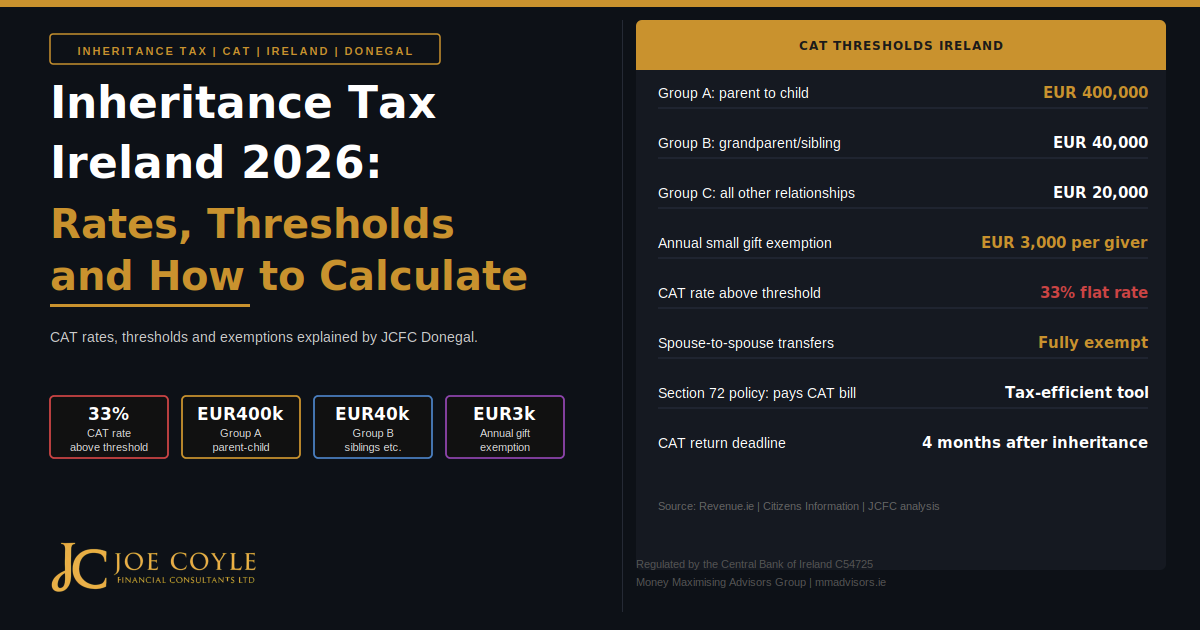
On the inheritance side, Capital Acquisitions Tax (CAT) at 33% applies to gifts and inheritances above the relevant group threshold. Careful Ireland tax planning is essential for anyone with significant assets:
Group A — €400,000: Gifts or inheritances from a parent to a child
Group B — €40,000: Siblings, nieces, nephews, grandchildren and grandparents
Group C — €20,000: All others, including unrelated individuals
These thresholds are lifetime aggregate limits. Every gift or inheritance received since 5 December 1991 in the same group is added together. Given Irish property values, many Donegal and nationwide families now exceed these thresholds on the family home alone.
2. Pension Contributions: The Most Powerful Legal Tax Reduction Tool in Ireland
For almost every high earner in Ireland, maximising pension contributions is the single most effective legal tax reduction strategy available. Here is why:
40% income tax relief: Every euro you contribute to a pension reduces your income tax liability by 40p (at the higher rate)
PRSI savings: Employee pension contributions also attract PRSI relief
Tax-free growth: The pension fund grows free of income tax, CGT, and DIRT inside the wrapper
25% tax-free lump sum at retirement: Up to €200,000 can be taken as a lump sum at retirement free of income tax
The age-related contribution limits, ranging from 15% of net relevant earnings under age 30 up to 40% over age 60, on earnings up to €115,000, mean that the opportunity to make large tax-relievable contributions increases as you approach retirement. Many clients in their 50s make very large ‘catch-up’ contributions in their final years before retirement.
For company directors, the company can make pension contributions on the director’s behalf as a deductible business expense, removing the contribution from the company’s corporation tax base as well. This is one of the most powerful planning tools available to Donegal business owners and company directors nationwide.
► Explore Pension Tax Relief View Our Pensions Advice
3. Inheritance Tax Planning: Reducing Your Family’s CAT Exposure
Estate planning in Ireland requires forward thinking. By the time a family home or business is being passed on, it may be too late to use the most effective planning tools. Here are the key strategies for inheritance tax advice Ireland for Donegal families and nationwide clients:
The Small Gift Exemption: €3,000 Per Recipient Per Year
The Small Gift Exemption allows any individual to give up to €3,000 per recipient per calendar year without using any of the Group A, B or C lifetime threshold. Two parents can give €6,000 per year to each child, every year, outside the CAT net. Over 20 years, that is €120,000 per child gifted free of inheritance tax. Combined with a Small Gift Exemption Savings Plan (available through Money Maximising Advisors at mmadvisors.ie), these annual gifts can be invested to grow further.
Section 72 Life Insurance Policies
A Section 72 Policy is a life assurance policy specifically designed under Irish tax planning strategies Ireland to pay the CAT bill on an estate without the policy proceeds themselves being subject to CAT. This is the most common planning tool for Donegal families who own property or a business that will generate a large inheritance tax bill for the next generation.
Without a Section 72 Policy, the beneficiaries may need to sell the family home, farm, or business to meet the CAT bill. With a correctly structured Section 72 Policy, the insurance pays the CAT in full, allowing the asset to transfer intact. Joe Coyle Financial Consultants works with all major Irish providers, including Irish Life, Zurich, New Ireland, and Aviva, to structure appropriate Section 72 coverage for clients.
Agricultural Relief: 90% Reduction for Qualifying Farmland
Agricultural Relief reduces the taxable value of qualifying farmland and farm assets by 90%, dramatically reducing or eliminating the CAT bill for farm-inheriting children. The beneficiary must meet the ‘farmer test’ broadly, 80% of their assets after the inheritance must be agricultural, and must either farm the land themselves or let it on a long-term lease for six years. This is critical planning for Donegal farming families.
Business Relief: 90% Reduction for Trading Business Assets
Business Relief is the equivalent for trading businesses. If a Donegal business owner passes a qualifying trading company or sole trader business to the next generation, the taxable value is reduced by 90%. The disponer must have owned the business for at least two years before an inheritance (five years before a gift). The business must be a genuine trade, not a passive investment vehicle. Early structuring with an advisor is essential to ensure the business qualifies.
Dwelling House Exemption
Where a child has lived in the family home with a parent for at least three years before the parent’s death, owns no other property at the date of inheritance, and continues to live in the inherited home for six years afterwards, the home can pass CAT-free regardless of its value. This exemption can save tens of thousands of euros for qualifying Donegal families. The conditions are strict and must be verified with an advisor.
► Get Inheritance Tax Planning Advice Contact Our Donegal Experts
4. Income Tax Strategies Beyond Pensions: Key Reliefs for High Earners
Mortgage Interest Relief (Section 244)
Interest on loans used to acquire, improve or repair a rental property is deductible against rental income. Donegal landlords and nationwide property investors should ensure their rental accounts correctly claim all available interest relief.
Employment of a Spouse or Family Member
Where a business owner legitimately employs a spouse or family member, the salary paid is deductible against business income. The spouse uses their own standard rate band and personal credits, potentially saving significant tax at the marginal rate. Salaries must be commercially justifiable and actually paid to meet Revenue requirements.
EIIS (Employment and Investment Incentive Scheme)
EIIS allows individuals to invest in qualifying Irish SMEs and claim income tax relief at 35% on investments up to €250,000 per year. The investment must be held for at least four years. EIIS is suitable for high earners looking to improve their income tax planning while supporting Irish business growth.
Capital Gains Tax (CGT) Planning
Ireland’s CGT rate is 33%. For business owners and investors, careful timing of asset disposals, including the use of the €1,270 annual CGT exemption and retirement relief on qualifying business assets, can materially reduce tax legally on the sale of assets. Retirement Relief can exempt CGT entirely on the disposal of qualifying business or farm assets by individuals aged 55+ up to certain thresholds.
5. Corporate Tax Planning for Donegal Business Owners
For business owners operating through a company, the interaction between salary, dividends, pension contributions, and the company’s tax position requires careful modelling. Key strategies include:
Director’s pension contributions: As above, the most tax-efficient method of extracting value from a company
Salary versus dividends: The optimal split between salary and dividends depends on the Standard Rate Band, PRSI credits, and the company’s profits. It changes each year and should be reviewed annually
Corporate cash management: Excess cash sitting in a trading company may be at risk of losing Business Relief for CAT purposes. Investment in a qualifying Corporate Investment can be more tax-efficient than leaving cash idle
Entrepreneurs’ Relief (CGTR): On the sale of a qualifying business, the CGT rate reduces to 10% on the first €1 million of gain. For Donegal business owners planning an exit, these tax-saving strategies should be structured well in advance.
► Discuss Corporate Tax Planning Contact Joe Coyle
Frequently Asked Questions: Inheritance Tax and Income Tax Advice Ireland
How can high earners legally reduce tax in Ireland?
The most effective tools are: maximising pension contributions (40% income tax relief), using the Small Gift Exemption (€3,000 per recipient per year outside the CAT net), structuring Section 72 Policies for the CAT bill, claiming Agricultural or Business Relief on qualifying assets, and using EIIS investments. Each strategy should be reviewed with a Qualified Financial Advisor.
What tax reliefs are available in Ireland in 2026?
Income tax reliefs include pension contributions, mortgage interest on rental properties, EIIS investments, and employment of a spouse. CAT reliefs include the Small Gift Exemption, the Dwelling House Exemption, Agricultural Relief (90%), Business Relief (90%), and the spouse exemption. CGT reliefs include the annual €1,270 exemption, retirement relief, and Entrepreneurs’ Relief.
What is the best tax-saving strategy for company directors in Ireland?
For most company directors, maximising director pension contributions is the single most tax-efficient strategy. Contributions are deductible against corporate profits, avoid personal income tax, and build a retirement fund growing free of tax inside the pension wrapper. Directors approaching retirement should also consider ‘self-administered’ executive pensions which offer greater investment flexibility.
Can pension contributions reduce my tax bill in Ireland?
Yes, significantly. Pension contributions receive income tax relief at your marginal rate (20% or 40%). For a higher-rate taxpayer, every €1,000 contributed costs only €600 after tax relief. The annual contribution limits are age-related and generous, especially for those aged 50 and over.
How much tax relief can I claim on pension contributions?
The earnings cap for relief is €115,000. The percentage of earnings you can contribute ranges from 15% (under 30) to 40% (age 60+). At the higher rate, the maximum potential annual tax relief for someone aged 60+ earning €115,000 is up to €18,400 — a very significant tax saving.
► Ready to Reduce Your Tax Bill? Book a Free Consultation
Important Information
This article is for general information purposes only and does not constitute financial, tax or legal advice. CAT thresholds, income tax rates, and reliefs referenced are correct as at July 2026, drawn from Revenue.ie and Citizens Information. Thresholds and rates may change in future Budgets. Joe Coyle Financial Consultants Ltd is regulated by the Central Bank of Ireland (C54725), part of the Money Maximising Advisors group (C154250). Always seek personalised advice from a Qualified Financial Advisor and a tax adviser before acting.
Written by: Joe Coyle Financial Consultants Ltd | jcfc.ie | info@jcfc.ie | +353 091 342596
Part of Money Maximising Advisors Group | mmadvisors.ie | moneysense.ie